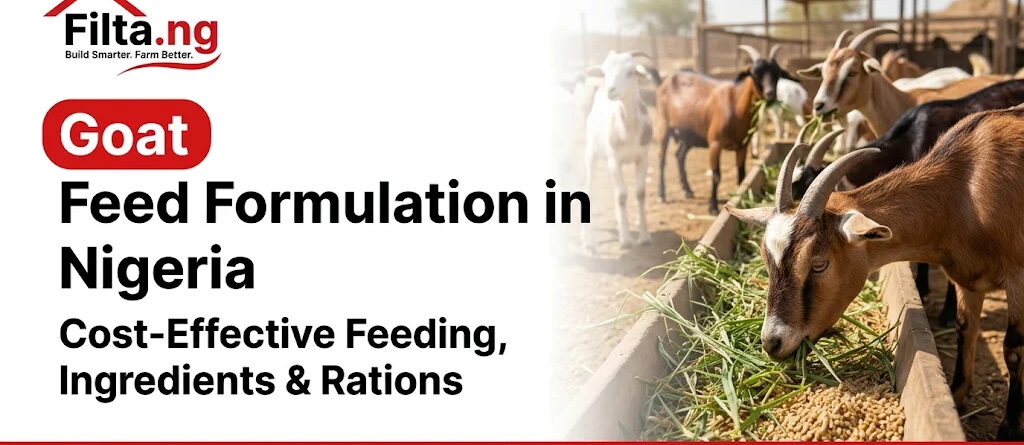
Goat farming is an important part of livestock production in Nigeria. Goats are raised for meat, breeding and commercial livestock production.
One of the important factors in successful goat farming is proper nutrition. Providing the right combination of feed ingredients helps support healthy growth, body condition, reproduction and overall productivity.
For farmers looking to manage feeding expenses, formulating supplementary goat feed using locally available ingredients can be a practical option.
In this guide, we share a goat feed formulation using maize, wheat bran, palm kernel cake, groundnut cake and soybean meal, including the quantities and estimated cost of producing 100kg of feed.
1. Ingredients Required for Goat Feed
The following ingredients are used in this formulation:
- Maize
- Wheat Bran
- Palm Kernel Cake (PKC)
- Bone Meal
- Salt and Mineral Mix
- Groundnut Cake (GNC)
- Soybean Meal
These ingredients provide different nutrients that contribute to the nutritional composition of the feed.
Maize provides energy, while groundnut cake and soybean meal contribute protein. Wheat bran and PKC provide fibre and energy, while bone meal and mineral supplements contribute essential minerals.
2. Goat Feed Formulation and Cost of 100kg
Below is the ingredient breakdown for producing 100kg of supplementary goat feed.
| Ingredient |
Quantity |
Unit Price |
Total |
| Maize |
44kg |
₦400 |
₦17,600 |
| Wheat Bran |
20kg |
₦480 |
₦9,600 |
| PKC |
10kg |
₦350 |
₦3,500 |
| Bone Meal |
2kg |
₦350 |
₦700 |
| Salt + Mineral Mix |
2kg |
₦3,200 |
₦6,400 |
| Groundnut Cake |
14kg |
₦800 |
₦11,200 |
| Soybean Meal |
8kg |
₦850 |
₦6,800 |
| Total |
100kg |
|
₦55,800 |
3. Additional Production Costs
Apart from purchasing the ingredients, farmers should account for the cost of milling, packaging and transportation.
| Description |
Cost |
| Milling (100kg × ₦25) |
₦2,500 |
| Sack |
₦1,000 |
| Transport |
₦3,000 |
| Total Additional Costs |
₦6,500 |
Total Cost of Goat Feed Production
- Ingredient cost: ₦55,800
- Milling: ₦2,500
- Sack: ₦1,000
- Transport: ₦3,000
Total estimated cost: ₦62,300
This gives an estimated delivered cost of ₦623 per kilogram.
Excluding transportation, the production cost is ₦59,300, or ₦593 per kilogram.
4. Nutritional Importance of the Ingredients
Understanding the purpose of each ingredient helps farmers make informed decisions about livestock feeding.
Maize
Maize is an important energy source. It provides carbohydrates that help meet the energy requirements of growing goats.
Wheat Bran
Wheat bran provides fibre, energy and other nutrients. It contributes to the overall composition of supplementary feed.
Palm Kernel Cake (PKC)
PKC is an agricultural by-product used in livestock feeding. It provides fibre and energy, although its nutritional composition varies depending on processing quality.
Groundnut Cake (GNC)
Groundnut cake is a protein-rich ingredient that contributes to muscle development and growth.
Soybean Meal
Soybean meal is another important protein source used in livestock feed formulation.
Bone Meal
Bone meal supplies calcium and phosphorus, which are important for bone development.
Salt and Mineral Mix
Minerals play important roles in metabolism, growth, reproduction and general animal health. Farmers should use a livestock mineral premix appropriate for goats and follow its recommended inclusion rate.
5. Important Feeding Tips for Goats
Although formulated supplementary feed can help improve goat nutrition, it should not replace the animals' normal roughage-based diet.
Here are some important feeding considerations:
- Provide adequate forage: Goats naturally browse and benefit from grasses, leaves, shrubs and other suitable forage.
- Provide clean water: Ensure goats have access to fresh drinking water throughout the day.
- Introduce new feed gradually: Avoid sudden changes in feeding routines, particularly when introducing concentrate.
- Avoid mouldy ingredients: Poor-quality or contaminated feed ingredients can affect animal health.
- Provide appropriate minerals: Use mineral supplements specifically formulated for goats.
- Monitor body condition: Adjust feeding according to the animals' age, weight, pregnancy status and production needs.
Important nutritional note: This is a costed supplementary feed formulation, not a nutritionally validated complete goat ration. Goats require adequate forage and roughage. The formulation should be reviewed by a qualified livestock nutritionist to confirm its crude protein, energy, fibre, mineral balance and suitability for the intended class of goats. Salt and mineral inclusion should also be checked against the manufacturer's specifications.
6. Conclusion
Proper feeding is essential for successful goat production. Using locally available ingredients to prepare supplementary feed can help farmers manage feeding expenses while providing additional nutrients to their animals.
However, good livestock management goes beyond feed formulation. Farmers should combine appropriate feeding, clean water, proper housing, disease prevention and regular monitoring to maintain healthy animals.
At Filta.ng, we are committed to providing practical agricultural information and helping Nigerian farmers access essential farming inputs.
Filta.ng – Build Smarter. Farm Better.